
Nine Failed Samples Should Not Become Nine Issues
What RootTrace groups automatically, and what it deliberately leaves separate
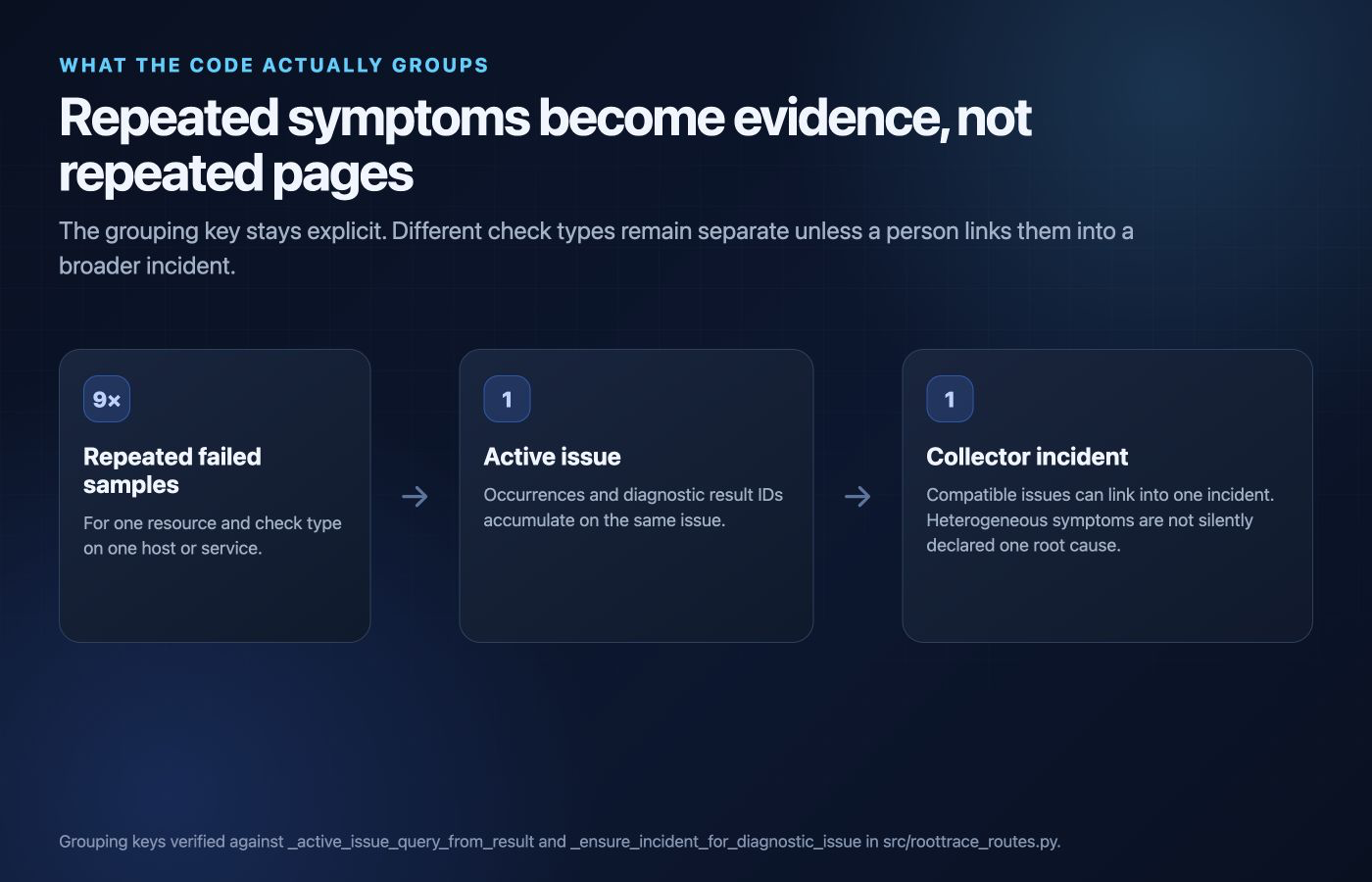
Imagine that at 02:14 a disk I/O check crosses its threshold on one database resource. It fails again on the next run, and again after that. By 02:18 the collector has recorded nine failed samples for the same resource and check type.
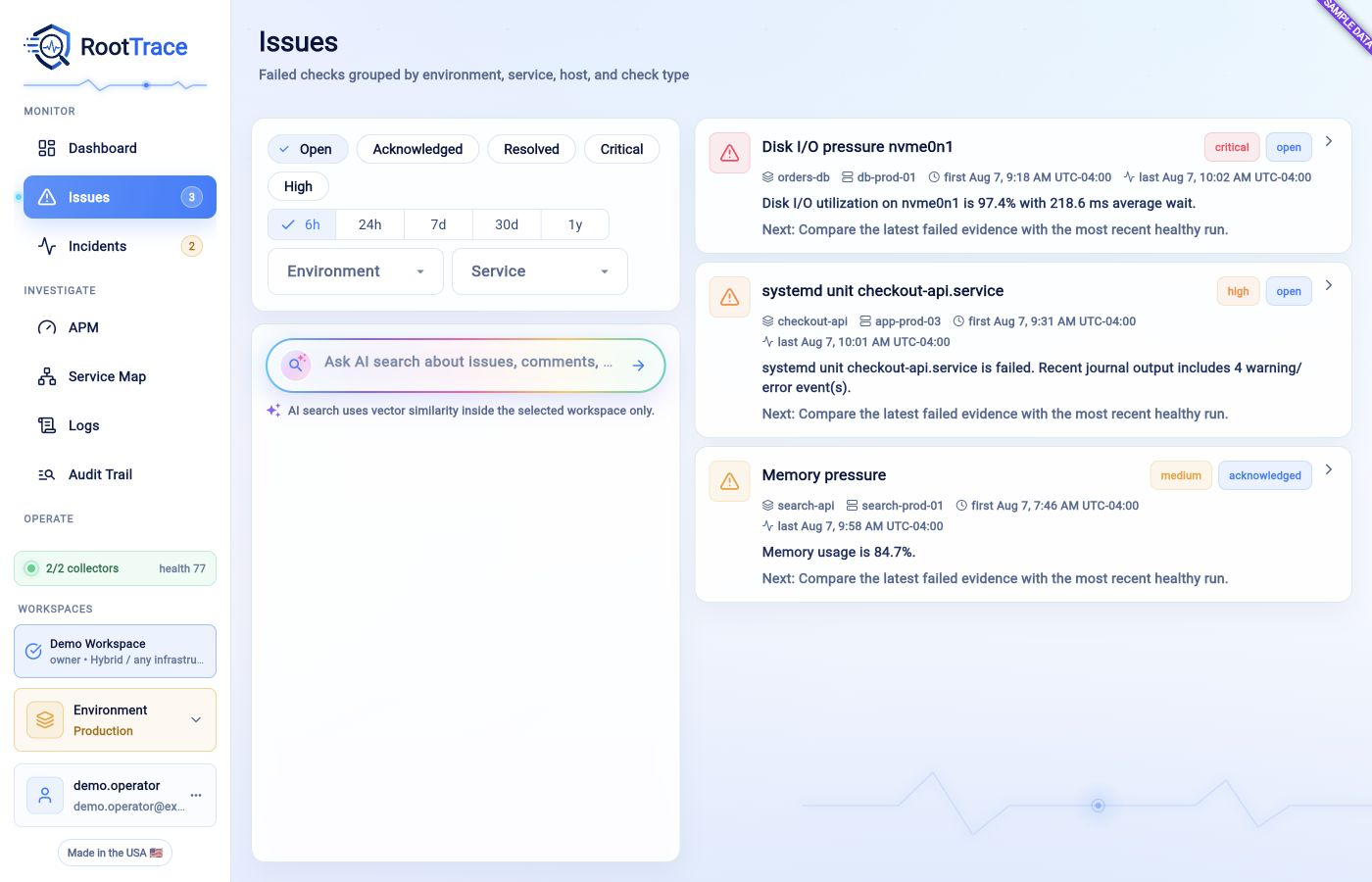
Those repeated samples should not become nine separate issues. RootTrace keys the active issue by organization, environment, service, host, check type, and resource key, so compatible repeats accumulate on one issue.
At 02:21 the operator opens one row, sees nine occurrences and the latest collector evidence, and starts with the resource that is failing. They do not spend the first minutes closing eight duplicates before the investigation can begin.
The pile is the problem
This does not mean every simultaneous symptom is automatically one root cause. Disk pressure, HTTP latency, and memory pressure have different check types and resource keys, so RootTrace keeps them as separate issues unless a human links them into a broader incident. Declaring them identical would be correlation by guesswork.
Correlation is often the slow part. The archaeology is deciding which issue is a cause, which is a consequence, and what changed.
So the useful question for any incident tool is not "how fast does it alert." It is "how much of the archaeology arrives with the alert."
One issue should carry the investigation forward
RootTrace groups repeated compatible results into one active issue. Collector incidents may then link compatible resources that share the same organization, environment, service, host, source, check type, and scope. Heterogeneous symptoms remain separate until somebody has evidence to connect them.
Grouping is only the first product benefit. What matters more is what rides along with the group, because every incident asks the same four questions and they are usually answered in the same order.
What broke? The issue carries the repeated occurrences and diagnostic result IDs for one resource and check type. It does not claim that a different kind of failure has the same cause.
What changed? A timeline of thresholds crossed, kernel and audit events, and deploys, drawn on the same axis as the failure. "What changed" is a common first question, and answering it often means opening another tool and lining up timestamps by eye. Putting the deploy marker on the outage band removes one of those lookups.
Has this happened before? This is easy to underestimate. Someone on the team may have seen this shape before, written it up, and then gone off shift. RootTrace scores past issues, notes, and postmortems in the workspace against the current evidence and surfaces close matches. When the answer is "yes, three weeks ago, and here are the notes," the operator starts with a prior hypothesis instead of a blank page.
That one is the exception to everything else in this piece, and it is worth stating plainly: the matching is vector search, so it needs Elasticsearch attached. Without it the search returns nothing rather than falling back to something weaker, and the ten-minute Compose stack does not include it. Grouping, the timeline, and the recommendations all work without it.
What do we do next? An evidence-backed recommendation with its risk and its manual steps. You approve it. Nothing runs on its own, ever, which is a deliberate constraint I will come back to.
Why "nothing runs on its own"
One possible next step is automated remediation: the system diagnoses, then applies a fix.
We do not do that, and the reason is narrower than a general position on AI safety. It is that a false positive which restarts your checkout service at peak can be worse than the incident it was trying to prevent. A correct automated fix may shorten an incident. An incorrect one can create an outage that did not otherwise exist.
Recommendations with evidence, risk, and manual steps keep the decision with the operator while reducing the amount of context they have to assemble. The human in the loop is not there for ceremony. They may know the thing the model does not: that this service is being migrated on Thursday, or that the last person who restarted it that way caused the incident three weeks ago.
The knowledge problem underneath all of this
Here is what actually happens on a team of five.
Your one senior engineer knows why the batch import causes replica lag. It is not written down. It is in their head, and it is reliable, and it is available whenever they are.
Then they take two weeks off, or they leave, and the next person to see that signature at 02:14 starts from zero. Not from the incident three weeks ago. From zero.
On a small team, reliability knowledge often sits with whichever engineer handled the last incident. Making issues, notes, and postmortems searchable reduces the cost of that knowledge being unavailable. It does not replace an SRE practice or guarantee a faster diagnosis.
What to measure
If you want to know whether your current setup has this problem, one useful number is alerts per incident.
Count the notifications fired during your last three real incidents, divide by three, and inspect the distribution rather than treating the average as a target of exactly one. A high ratio can reveal duplicate notification noise, but a multi-symptom incident can legitimately contain several distinct issues.
Create a safe incident and watch the grouping
RootTrace runs on your own hardware, free on five hosts, with no vendor account or licence key:
docker pull public.ecr.aws/byteaffinity/roottrace/server:latestThe pull alone starts nothing. The quickstart is one paste-able block that writes the Compose file and your bootstrap token, then docker compose up -d.
Put a collector on a non-production test box and break something on purpose. Fill a disposable volume or stop a test service. Watch whether repeated results update one issue, and whether different check types remain distinct until you link them.
RootTrace is self-hosted monitoring and incident intelligence for teams. Grouped issues, incident memory, and evidence-backed recommendations that never execute on their own. Free on five hosts. roottrace.io